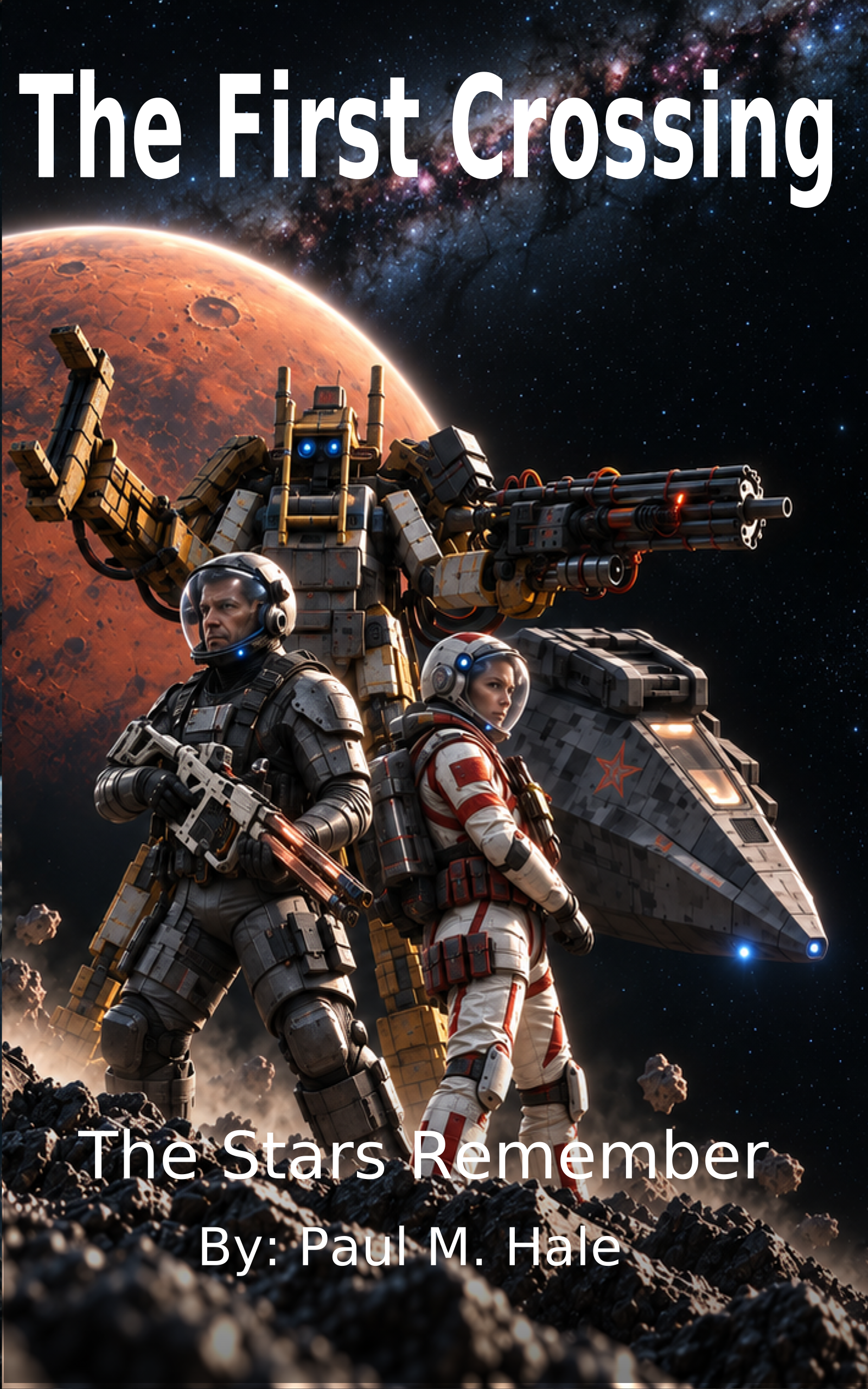
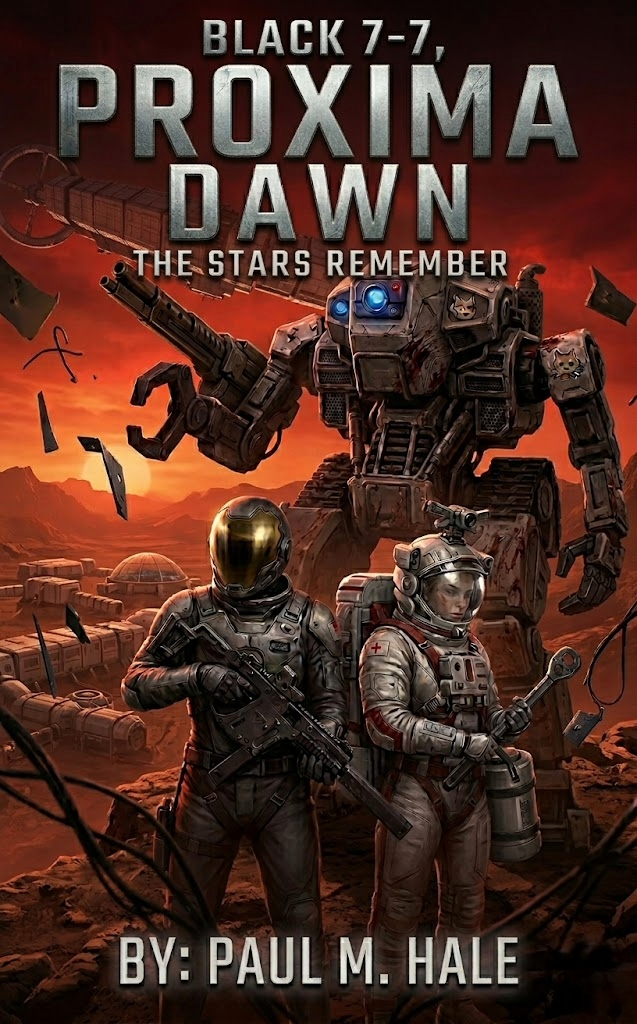
The Stars Remember Trilogy
World-Building
By 2098, the old world is no longer merely collapsing. It is being replaced.
Across Europe, North Africa, the Middle East, and the territories falling between them, the Green Crescent has grown from a regional alliance into an expansionist theocratic power. Ideological purification, demographic pressure, and state-directed violence have become instruments of the same project: the dismantling of the old Western order and the absorption—or removal—of the populations that once sustained it.
The transformation of the West does not begin with invasion. It begins slowly, through decades of mass migration without meaningful assimilation, widening cultural separation, and a demographic balance that shifts with each generation. As legacy populations age and contract, communities aligned with the emerging Green Crescent grow in size, political confidence, and electoral power.
What begins as accommodation becomes institutional dependence. Municipal governments, schools, courts, and political parties increasingly reshape themselves around constituencies whose political and cultural identity no longer depends on preserving the institutions they inherited. Parallel customs harden into parallel institutions; religious law gains recognition first as an exception, then as an expectation. Elections continue, but the society choosing its government is no longer the society that created the institutions being inherited.
By the time the Green Crescent emerges as a coherent political force, conquest is largely an administrative act. The remaining legacy populations are not defeated on a battlefield; they are rendered politically peripheral, culturally obsolete, and eventually expendable. The old legal order gives way piece by piece to a theocratic one, while the people who built and maintained the former civilization are increasingly classified according to what utility they still provide.
The regime that emerges from this upheaval does not need to hate everyone it destroys. It only needs to decide that some lives no longer justify the resources required to sustain them.
North America responds differently. As governments weaken and public institutions fail, national survival increasingly gives way to corporate survival. Industry retreats behind private security, controlled infrastructure, and the Ark Program, preserving the machinery of civilization even as the political order around it begins to fail.
Russia chooses a different form of survival. Project Iskhod is built almost entirely outside the Western Ark system: hundreds of vessels assembled for a mass exodus carrying more than a million people. When the fleet finally departs, it burns past Jupiter and into the interstellar dark, abandoning Earth before the forces closing around Russia can overtake what remains.
China answers collapse with control. As terrestrial borders harden and neighboring regions destabilize, Beijing secures strategic territory and builds an increasingly militarized orbital state. Tiangong-7 becomes part station, part fortress, and part weapons platform, defended by Dragonfang interceptors and the orbital kinetic weapons known as Dragon's Teeth. Its purpose is not exploration. It is survival through deterrence.
Into this fractured system come the people who were never meant to inherit anything.
They are not chosen colonists. They are not political leaders. They are not part of anyone's evacuation plan.
They are the remainder.
And the central question of The Stars Remember is not simply whether they can survive.
It is what happens when the people a civilization judged disposable become the ones carrying its future.
Science Background
The Stars Remember is unapologetically hard science fiction.
Its spacecraft obey orbital mechanics. Mass matters. Propellant matters. Heat has to go somewhere. Structures have limits. Every maneuver has a cost, and every kilogram carried into orbit has to justify itself.
The technology is extrapolated from real or plausible near-future engineering: nuclear-thermal propulsion, hypergolic maneuvering systems, rotating habitats, orbital construction, electromagnetic weapons, asteroid resource extraction, vacuum metallurgy, closed-loop life support, radiation protection, and long-duration human adaptation to reduced gravity.
Nothing arrives simply because the story needs it.
If they need metal, they have to mine it.
If they need propellant, they have to find the feedstock.
If they need a machine, they have to build it from what remains.
The series also treats biology as part of the engineering problem. Long-duration spaceflight changes bodies as surely as it changes machines, and the boundary between adaptation, survival, and evolution becomes increasingly important as humanity moves farther from Earth.
There are no faster-than-light drives and no convenient rescues. Distance remains distance. Energy must be paid for. Physics does not negotiate.
The extraordinary comes from what people manage to accomplish anyway.
This is science fiction that respects science, while never forgetting that the most important variable in any equation is still human.
All titles are Kindle‑exclusive during early release.